Table of Contents
ToggleThe Future of Health: Shaping a Healthier America
Author: RVLNSV PRASAD
Updated On: October 2026
About Us
Author Bio
Editorial Policy
Contact Us
Introduction
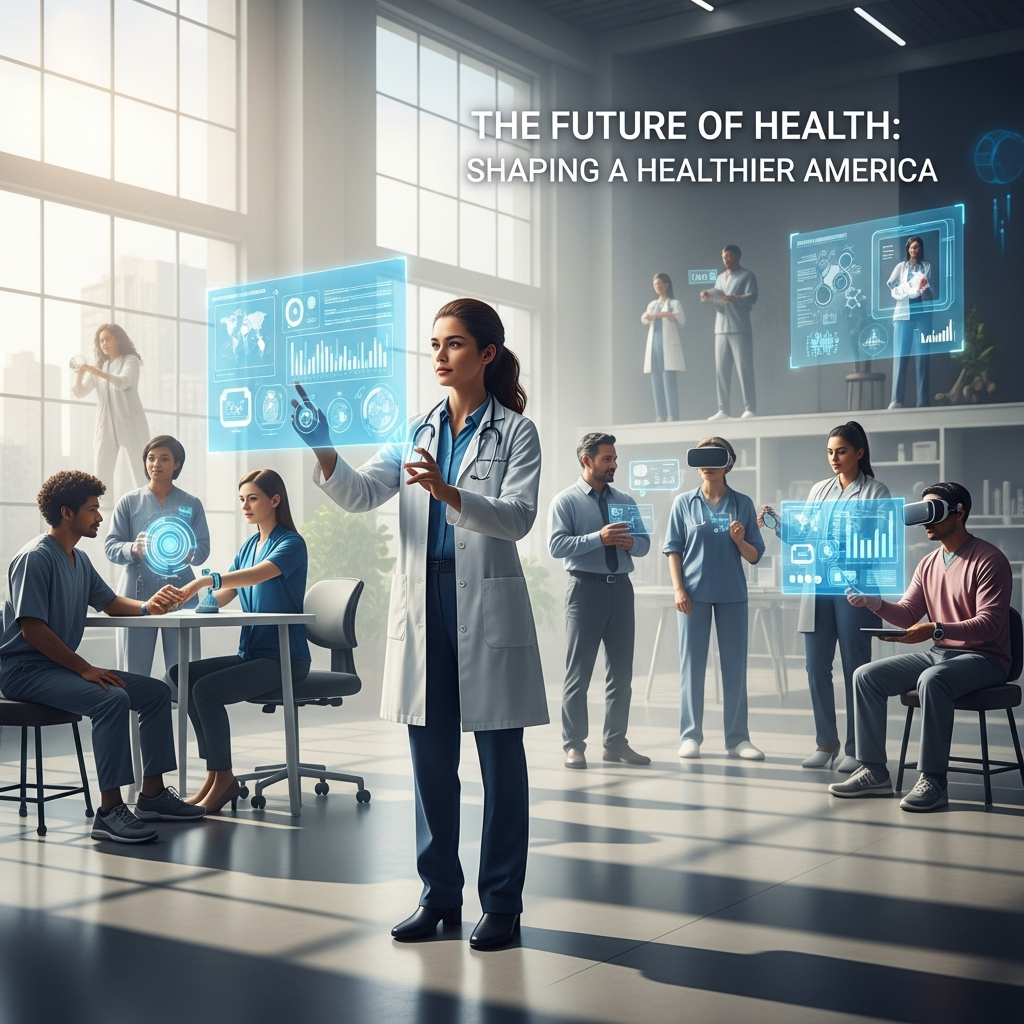
The future of healthcare in America is no longer just about building bigger hospitals or developing new medicines.
Healthcare is becoming more connected to everyday life.
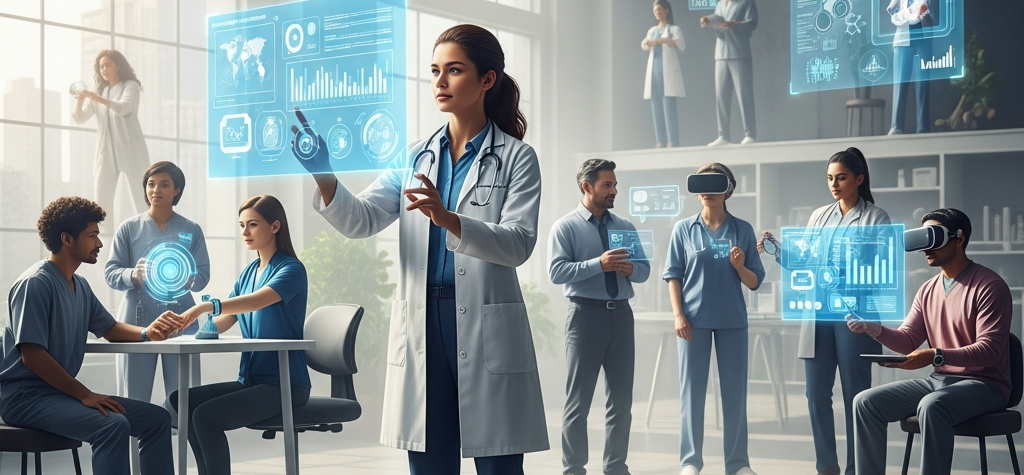
A person may use a wearable device to monitor activity. A patient may speak with a doctor through a virtual visit. An artificial intelligence system may help organize medical information. Remote monitoring may allow some patients to receive care without spending as much time in a hospital.
At the same time, many of the biggest healthcare challenges remain surprisingly familiar.
People still struggle with affordability. Some communities have fewer healthcare professionals. Chronic diseases continue to create a large burden. Mental healthcare can be difficult to access. Healthcare workers face pressure, and health information can be confusing.
That means the future cannot be defined by technology alone.
The more important question is:
Will new technology make healthcare easier to access, more understandable, more preventive and more useful for ordinary people?
Current healthcare research points toward several major changes, including digital care, artificial intelligence, remote monitoring, prevention, new care models and greater collaboration across healthcare and technology. The Deloitte 2026 U.S. Health Care Outlook identifies digital experiences, generative and agentic AI, and cross-industry collaboration as important areas of transformation.
PwC’s 2026 provider outlook similarly describes healthcare providers moving toward more decentralized care, digital platforms and AI-supported personalization. PwC — The Future of Healthcare Providers
This article looks beyond futuristic promises.
It explains what these developments could mean for an ordinary American patient, what is already happening, what remains uncertain, and which simple actions people can take today to prepare for a more technology-driven healthcare system.
Quick Answer: What Will the Future of Healthcare in America Look Like?
The future of healthcare in America is likely to combine traditional medical care with more digital, preventive and personalized services.
Important trends include:
- artificial intelligence in healthcare
- virtual and telehealth services
- remote patient monitoring
- wearable health technology
- preventive and earlier care
- healthcare delivered at home
- personalized medicine
- connected health records
- stronger emphasis on health equity
- new approaches to healthcare affordability
- changing healthcare workforce needs
- greater patient involvement in health decisions
However, these developments will not automatically improve healthcare.
AI can make mistakes. Digital tools can create privacy concerns. Wearables can generate information without providing useful clinical context. Virtual care cannot replace every physical examination. And new technology may widen inequality if people without reliable internet, devices or digital skills cannot use it.
The future therefore depends on how technology is implemented, not simply how advanced it becomes.
Key Takeaways
- Healthcare is moving from a mainly reactive model toward greater prevention and earlier intervention.
- AI is becoming increasingly important in clinical, administrative and patient-facing healthcare.
- Virtual care and remote monitoring can make some services more convenient.
- More healthcare may eventually be delivered in homes and community settings.
- Wearables can provide additional health information but should not replace medical evaluation.
- Personalized healthcare may use genetics, lifestyle, medical history and other information to guide care.
- Healthcare affordability remains a major challenge.
- Health equity must remain part of technological innovation.
- Human clinical judgment remains important even as AI becomes more capable.
- Patients will increasingly need basic digital and health literacy.
- Simple habits such as keeping medical records organized and understanding medications can make people better prepared for connected healthcare.
- The most useful future healthcare system will combine technology with human care.
1. Healthcare Is Moving From Treatment Toward Prevention
Traditional healthcare often becomes involved after a person develops symptoms.
The future is likely to place greater emphasis on identifying risk earlier.
That could mean detecting high blood pressure before complications develop, identifying cardiovascular risk earlier, monitoring diabetes more closely or helping people recognize changes in health before they require emergency care.
The Deloitte 2026 U.S. Health Care Outlook reports that only 38% of U.S. healthcare spending in its actuarial modeling is devoted to prevention, early detection and overall well-being, while healthcare organizations are increasingly considering digital tools and AI as part of changing care delivery.
This does not mean prevention will replace treatment.
People will still need:
- surgery
- emergency medicine
- cancer treatment
- intensive care
- specialist care
- medicines
- rehabilitation
The future is more likely to combine treatment with earlier intervention.
What This Means for an Ordinary Person
Prevention may become less about one annual appointment and more about continuous health management.
For example:
Today:
Annual checkup → test → result → follow-up
Emerging model:
Routine measurements → digital monitoring → risk identification → earlier consultation → personalized intervention
The Deloitte article on the future of health explores how prevention, early detection, health data and AI could contribute to this broader shift in healthcare.
The second model is still developing, but the direction is increasingly visible.
2. Artificial Intelligence Will Become Part of Healthcare
Artificial intelligence is one of the most discussed parts of the future of healthcare.
But AI in healthcare is much broader than a chatbot answering health questions.
Potential applications include:
- medical imaging
- clinical decision support
- documentation
- administrative work
- patient communication
- risk prediction
- research
- drug development
- remote monitoring
- personalized treatment support
The Deloitte 2026 U.S. Health Care Outlook reports that 49% of surveyed healthcare organizations were still experimenting with generative or agentic AI, while about one-third reported operating AI at scale. The report also describes expected applications across clinical, business and administrative functions.
That distinction is important.
AI adoption is growing, but healthcare is not suddenly becoming fully AI-driven.
AI May Reduce Some Administrative Work
Healthcare professionals spend substantial time documenting visits, processing information and dealing with administrative requirements.
AI tools may help summarize information, organize records or prepare documentation.
The Deloitte outlook describes healthcare organizations using generative and agentic AI for areas such as documentation, prior authorization and clinical workflows, while emphasizing human oversight for important decisions.
That could have an important patient benefit.
If clinicians spend less time on repetitive administrative work, more time may become available for communication and clinical care.
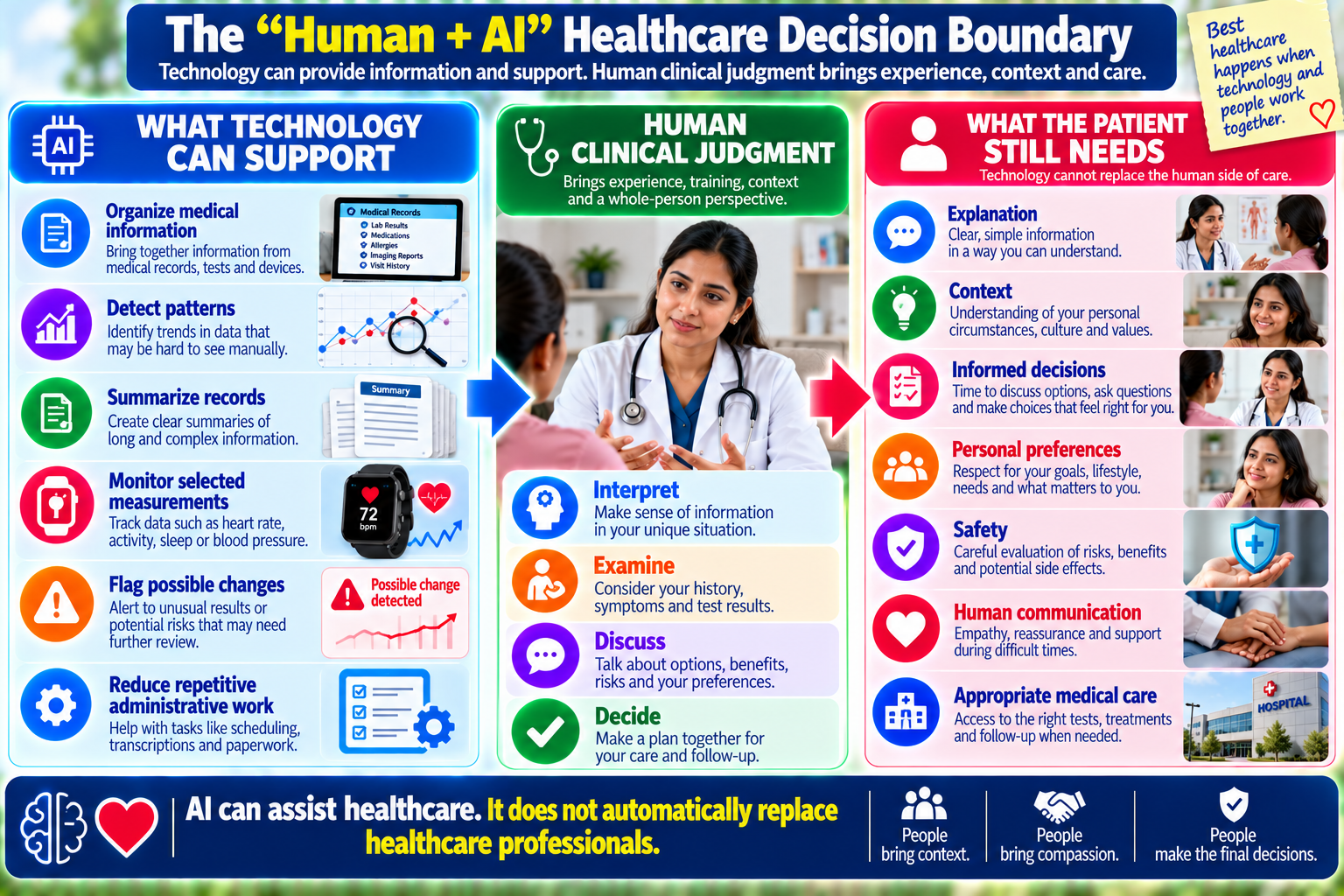
AI Should Not Be Treated as an Independent Doctor
This is one of the most important principles for the future.
AI can:
- identify patterns
- summarize information
- generate possibilities
- support decision-making
But healthcare decisions involve context.
A patient’s symptoms, history, examination, medications, preferences and circumstances can all matter.
Therefore:
AI should support healthcare professionals rather than automatically replace clinical judgment.
3. Virtual Healthcare Will Become More Normal
Telehealth became much more visible during the COVID-19 pandemic.
Its role continues to evolve.
Virtual appointments can be useful for:
- follow-up visits
- medication discussions
- behavioral health
- some chronic disease management
- reviewing test results
- certain routine consultations
The Deloitte 2026 U.S. Health Care Outlook reports that more than 90% of people in its referenced consumer survey who had a virtual health visit said they would be willing to have another. It also reports that 37% of consumers used monitoring devices for health conditions and another 47% used devices for fitness and health tracking.
Virtual care is particularly interesting for people who live far from specialists.
It may reduce:
- travel
- waiting-room time
- missed work
- transportation difficulties
But it does not replace every physical examination.
Chest pain, severe injuries, certain neurological symptoms and many other conditions may require in-person evaluation.
The future is therefore likely to be hybrid healthcare, rather than completely virtual healthcare.
4. More Healthcare Could Move Into the Home
One of the most significant potential changes is the expansion of care outside hospitals.
The PwC Care-at-Home Healthcare Strategy describes emerging care-at-home models supported by remote monitoring, AI, telehealth platforms, wearable connected devices and virtual command centers. PwC projects that care could become increasingly distributed and technology-enabled over the coming decade.
Imagine a patient recovering from a condition at home while selected information is transmitted to a healthcare team.
Depending on the situation, monitoring could include:
- blood pressure
- blood glucose
- heart rate
- oxygen saturation
- weight
- medication adherence
- symptoms
The healthcare team can then decide whether additional intervention is necessary.
Why Care at Home Could Matter
Hospital care is essential for serious illness.
But hospitals are not necessarily the ideal location for every stage of healthcare.
Home-based care may provide:
- greater comfort
- fewer unnecessary trips
- easier family involvement
- more convenient monitoring
- potential reductions in some healthcare burdens
PwC’s care-at-home analysis describes remote patient monitoring, AI-supported alert management and integrated digital platforms as important components of these emerging models.
The important word is potential.
Care-at-home models need appropriate patient selection, reliable technology, trained professionals and emergency pathways.
5. Wearable Health Technology Will Generate More Personal Data
Smartwatches and other wearable devices can already collect information such as:
- heart rate
- activity
- sleep patterns
- exercise
- sometimes heart rhythm
- other physiological measurements
The Deloitte 2026 U.S. Health Care Outlook reports substantial consumer use of monitoring and fitness devices and describes connected care as an opportunity for healthcare organizations.
The future could make this information more useful by connecting it with clinical records.
Instead of seeing:
“Your heart rate changed.”
A future healthcare system might help a clinician interpret:
“Your recent measurements differ from your previous pattern, and this may warrant further evaluation.”
That is a much more meaningful use of data.
But More Data Is Not Always Better
A wearable can produce thousands of measurements.
More information does not automatically mean better health.
People can become anxious about normal fluctuations.
A device can also produce inaccurate readings.
Therefore, wearable data should be interpreted in context rather than treated as a diagnosis.
6. Personalized Healthcare Will Become More Important
Medicine has traditionally relied heavily on population-level evidence.
That remains essential.
But healthcare is increasingly interested in differences between individuals.
Personalized healthcare may consider:
- genetics
- age
- medical history
- medications
- lifestyle
- environment
- laboratory results
- wearable information
- disease characteristics
The Deloitte 2026 U.S. Health Care Outlook describes integrated platforms bringing together electronic health records, imaging, genomics, and wearable-device information to support advanced analytics and precision health.
The goal is not simply
“What treatment works for most people?”
It increasingly becomes
“Which approach is appropriate for this particular patient?”
That could eventually improve treatment selection and reduce unnecessary interventions.
However, personalized medicine should not be confused with internet companies making unsupported claims based on a consumer DNA test.
Clinical interpretation matters.
7. Healthcare Data Will Become More Connected
One of healthcare’s long-standing problems is fragmented information.
A person may have:
- a primary-care doctor
- a specialist
- a hospital
- a pharmacy
- a laboratory
- an imaging center
Each may hold different information.
Connected digital platforms could reduce some of this fragmentation.
The Deloitte 2026 U.S. Health Care Outlook discusses digital platforms designed to connect electronic health records, virtual care, monitoring applications, pharmacy and laboratory portals, patient records, and medication information.
The Patient Benefit
Imagine moving to another state and being able to provide your new doctor with an organized record containing:
- medications
- allergies
- previous diagnoses
- laboratory results
- imaging
- vaccination information
- specialist reports
That could reduce repeated testing and improve continuity.
The Privacy Challenge
More connected data also creates greater responsibility.
Healthcare systems need strong:
- cybersecurity
- access controls
- consent systems
- data governance
- privacy protections
The Deloitte 2026 Global Health Care Outlook identifies cybersecurity, workforce challenges, financial pressures, and healthcare transformation among the major issues shaping the sector.
A connected healthcare system that cannot protect patient information would create serious problems.
8. Healthcare Affordability Will Shape the Future
Technology receives a lot of attention.
Cost may ultimately determine whether people can use it.
The Deloitte 2026 U.S. Health Care Outlook identifies affordability of healthcare coverage and medical services as one of the defining concerns for the U.S. healthcare sector in 2026.
Deloitte’s July 2026 midyear outlook also describes affordability, access, and financial pressures as important issues as health plans and health systems move through the second half of 2026.
A future healthcare system can have excellent technology and still fail people if patients cannot afford it:
- insurance
- medications
- specialist care
- diagnostic testing
- preventive services
- transportation
- digital devices
That is why healthcare innovation should not be measured only by how advanced the technology is.
A more meaningful question is
Can ordinary people actually use it?
9. Health Equity Will Become More Important
The future of healthcare should not be designed only for people who have:
- fast internet
- smartphones
- wearable devices
- flexible working hours
- nearby specialists
- high health literacy
A rural patient and an urban patient may experience completely different healthcare systems.
Technology can help reduce that difference through telehealth and remote monitoring.
But technology can also widen it if access is unequal.
The Deloitte 2026 U.S. Health Care Outlook specifically discusses virtual and remote care as potential ways to reach people who experience care gaps, including people living in rural communities with limited access to services and specialists.
A People-First Test for New Healthcare Technology
Before celebrating a new health technology, ask:
- Who can afford it?
- Who can access it?
- Who understands how to use it?
- Does it work for older adults?
- Does it work in rural areas?
- What happens when the technology fails?
- Who is responsible for the decision?
Those questions are often more important than the technology itself.
10. The Healthcare Workforce Will Change
Doctors, nurses, and other healthcare professionals will remain essential.
Their jobs may change as technology takes over some repetitive tasks.
AI could potentially assist with:
- documentation
- scheduling
- data analysis
- information retrieval
- administrative workflows
That may allow professionals to spend more time on:
- patient communication
- complex decisions
- procedures
- empathy
- coordination
- clinical judgment
The Deloitte 2026 Global Health Care Outlook identifies workforce challenges and productivity alongside financial pressures, cybersecurity, and care-model transformation as major issues affecting healthcare organizations.
Technology, therefore, should not be viewed simply as a replacement for healthcare workers.
A better model is
Human expertise + technology + patient participation
What Will Healthcare Feel Like for an Ordinary Patient?
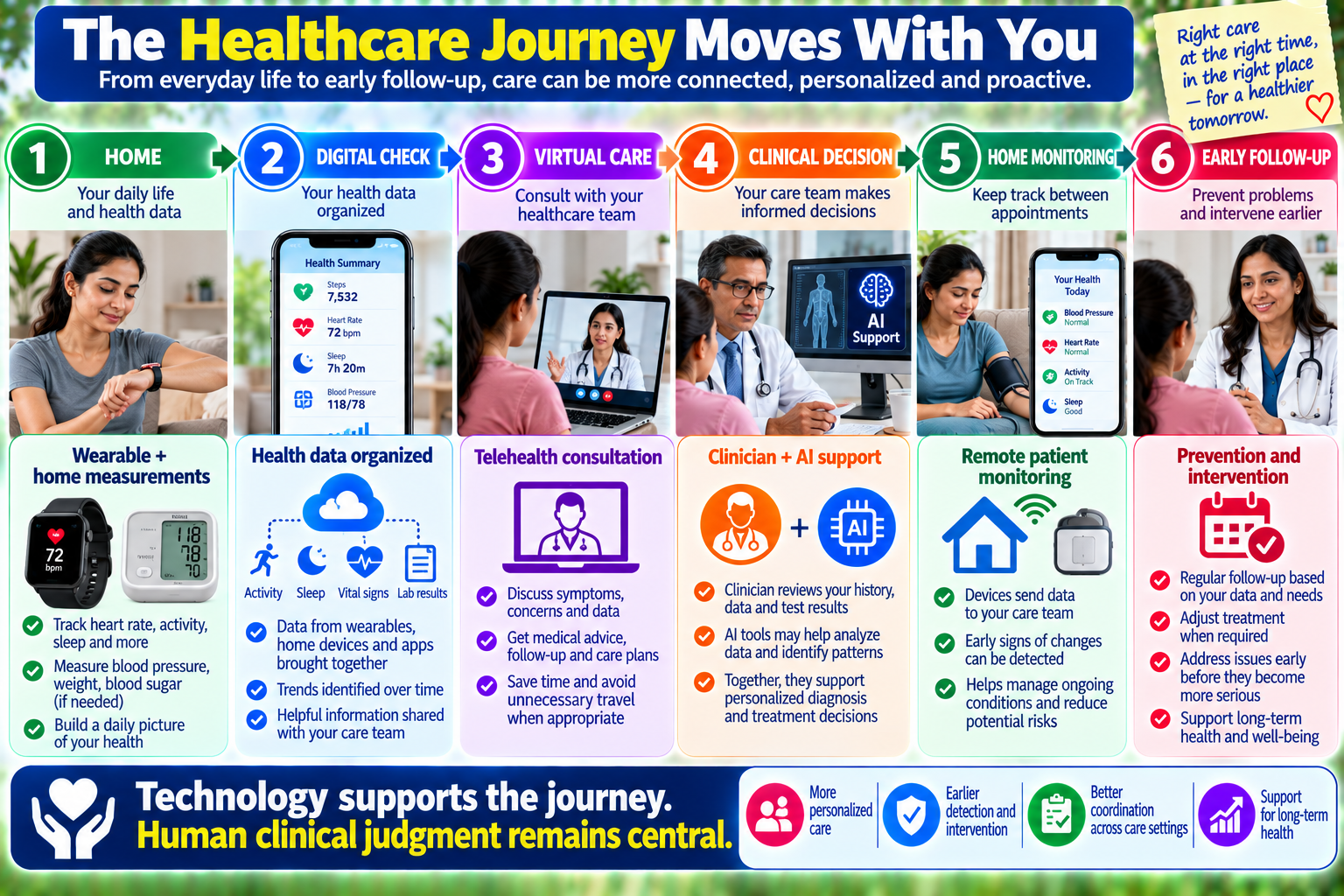
This is where the future becomes easier to understand.
Imagine someone named David.
Today, David may:
- schedule a doctor appointment
- travel to the clinic
- describe symptoms
- undergo tests
- wait for results
- return for follow-up
- manage treatment at home
In an increasingly connected healthcare system, parts of that journey could become:
- wearable or home measurements identify a change
- digital systems organize the information
- virtual consultation occurs
- The clinician reviews the data
- appropriate testing is ordered
- treatment is personalized
- monitoring continues at home
Not every patient will experience this model.
Not every condition is suitable for remote care.
But the overall direction is consistent with the PwC Future of Healthcare Providers report, which describes a future in which providers could decentralize services and use digital platforms and AI to personalize and empower care.
The Future of Mental Healthcare
Mental health should not be separated from the broader healthcare system.
Future healthcare may increasingly integrate:
- virtual therapy
- digital mental health tools
- primary-care screening
- remote consultations
- community services
- medication management
- crisis support
Technology may improve access, particularly for people who have difficulty traveling to a clinic.
However, mental health technology must be evaluated carefully.
An app cannot automatically provide the same care as a trained mental health professional.
Human connection remains important.
The Future of Chronic Disease Management
Chronic diseases require long-term management.
Examples include:
- diabetes
- hypertension
- cardiovascular disease
- obesity
- chronic respiratory diseases
These conditions are well suited to some forms of remote monitoring because measurements can be collected repeatedly.
Instead of waiting months for a routine appointment, selected patients may eventually have more continuous interaction with healthcare teams.
The goal would be
Detect change early → respond early → prevent deterioration when possible.
That is very different from waiting until symptoms become severe.
The Future of Healthy Aging
Americans are living longer, making healthy aging an increasingly important healthcare issue.
Future healthcare will need to address not only lifespan but also:
- mobility
- independence
- cognitive health
- social connection
- nutrition
- medication management
- fall prevention
- chronic disease
- home safety
Technology may assist with monitoring.
But healthy aging will still depend heavily on ordinary behaviors.
Strength training, physical activity, nutritious food, adequate sleep, social connection, and preventive care will not become obsolete simply because healthcare becomes more digital.
What Individuals Can Do Today
You do not need to wait for future healthcare technology.
Several practical actions can make you better prepared now.
Keep an Organized Health Record
Maintain a simple record of:
- current medications
- allergies
- major diagnoses
- surgeries
- vaccination history
- important laboratory results
- specialist contacts
Digital records can help, but keep a backup of important information.
Know Your Numbers
Depending on your age and health status, discuss appropriate monitoring with your healthcare professional.
This may include:
- blood pressure
- blood glucose
- cholesterol
- weight
- other relevant measurements
The goal is not to obsess over numbers.
It is to understand meaningful trends.
Learn to Evaluate Health Information
The future will produce more health information, not less.
Before believing a health claim, ask:
Who published it?
What evidence supports it?
Is the claim based on humans or laboratory research?
Is it selling something?
Does a reputable medical organization agree?
This simple habit may become one of the most valuable forms of health literacy.
Use Technology as a Tool
A health app can help you:
- remember appointments
- track activity
- monitor selected measurements
- organize information
But don’t allow an app to make you unnecessarily anxious.
Use data to support decisions, not to replace common sense or professional evaluation.
A Future-Ready Health Routine
You can think of future healthcare as a combination of technology and basic health habits.
| Area | Today | Emerging future |
|---|---|---|
| Prevention | Checkups and screening | Continuous risk monitoring |
| Exercise | Activity tracking | Personalized activity feedback |
| Nutrition | General dietary advice | More individualized guidance |
| Chronic disease | Periodic appointments | Remote monitoring |
| Medical records | Multiple systems | More connected platforms |
| Healthcare access | In-person + telehealth | Hybrid care |
| Diagnosis | Clinical evaluation | Clinical evaluation + AI support |
| Treatment | Population evidence | Increasing personalization |
| Home care | Limited in some settings | More remote and home-based care |
| Patient role | Receive information | Increasingly active participant |
The technology may change rapidly.
The fundamentals of good health will not disappear.
Common Mistakes People May Make With Future Healthcare Technology
Mistake 1: Believing AI Is Always Correct
AI can produce inaccurate information.
Mistake 2: Treating a Wearable as a Doctor
A device can identify a measurement.
A clinician interprets it within a medical context.
Mistake 3: Tracking Everything
More data can sometimes create more anxiety.
Track information that has a useful purpose.
Mistake 4: Ignoring Privacy
Understand how an app collects, stores, and shares your health information.
Mistake 5: Assuming Virtual Care Can Replace Everything
Some conditions require physical examination, testing, or emergency treatment.
Mistake 6: Waiting for Future Technology to Improve Health
You do not need an advanced wearable to walk regularly, eat nutritious foods, sleep adequately, or attend recommended preventive appointments.
Mistake 7: Assuming Innovation Automatically Means Better Care
A new technology is valuable only when it improves something meaningful.
Latest Research Developments in 2026
AI Is Moving From Experiments Toward Broader Implementation
The Deloitte 2026 U.S. Health Care Outlook reports that many healthcare organizations remain in the experimentation phase with generative and agentic AI, while only about one-third reported operating AI at scale.
The picture became more nuanced by mid-2026. Deloitte’s 2026 U.S. Health Care Midyear Outlook found that AI initiatives launched during the previous two years were roughly divided into three groups: initiatives that had scaled, those remaining in pilot or limited use, and those that had been paused or abandoned.
This suggests that 2026 is not the end point of healthcare AI.
It is an implementation phase in which organizations are increasingly testing what actually produces value.
Healthcare Is Becoming More Distributed
The PwC Future of Healthcare Providers report describes a 2035 vision in which providers could decentralize services and use digital platforms and AI to empower clinicians and personalize care.
Its care-at-home research similarly describes remote monitoring, virtual check-ins, and technology-enabled care coordination as components of emerging home-care models.
Prevention and Early Detection Remain Central Themes
The Deloitte report on the future of health examines how prevention, early detection, health data, and AI could contribute to a changing healthcare model.
This could eventually change healthcare from
“Treat the disease when it appears.”
toward:
“Identify risk and intervene earlier when appropriate.”
Healthcare Transformation Will Not Be Uniform
One of the most important findings from current industry research is that adoption differs substantially between organizations.
The Deloitte 2026 Global Health Care Outlook highlights workforce challenges, financial pressure, cybersecurity, and transformation as continuing issues even as AI and digital healthcare develop.
That means articles about “the future” should distinguish between:
Already happening
and
Projected or emerging.
This article follows that distinction rather than presenting predictions as established facts.
A People-First Test for the Future of Healthcare
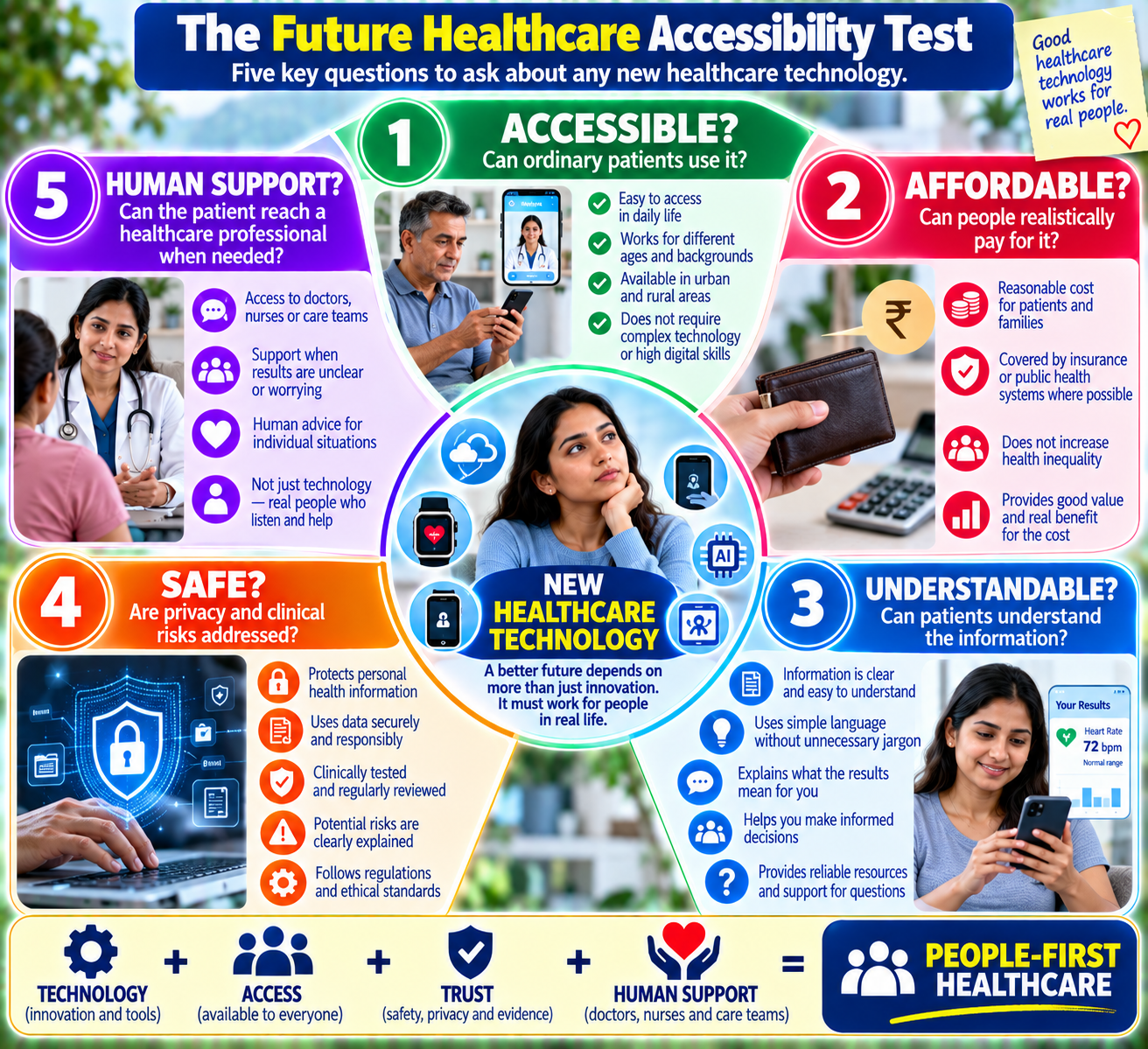
Whenever a new healthcare technology appears, ask five questions:
Is it useful?
Does it solve a real problem?
Is it accessible?
Can ordinary patients use it?
Is it understandable?
Can patients understand what the information means?
Is it safe?
Are privacy, cybersecurity, and clinical risks addressed?
Is there human support?
Can a person speak to an appropriate healthcare professional when necessary?
If the answer to these questions is yes, technology has a much better chance of improving healthcare rather than simply making it more complicated.
Personal Experience and Perspective
As I have researched health, wellness, and lifestyle topics, one pattern has become increasingly clear to me: people do not usually struggle because they lack access to information.
They often struggle because there is too much information.
A person can find hundreds of health apps, thousands of articles, and countless social media recommendations within minutes.
The challenge is knowing which information deserves trust.
That is why I believe the future of healthcare should not only become more technologically advanced.
It should become easier for ordinary people to understand.
Technology should simplify appropriate decisions rather than create another layer of confusion.
This is a personal perspective, not a clinical or policy recommendation.
What the Future Should Not Lose
Healthcare can become more digital without becoming less human.
A patient may appreciate:
- faster test results
- virtual appointments
- AI-assisted documentation
- remote monitoring
but still want a doctor who listens.
A person may appreciate a health app but still need someone to explain an abnormal result.
A wearable may identify a potential problem, but the patient may need reassurance, examination, and appropriate medical care.
The future should therefore combine:
Technology + evidence + human judgment + patient trust
That combination is more important than any individual gadget.
Frequently Asked Questions
What is the future of healthcare in America?
The future of healthcare in America is likely to involve greater use of AI, virtual care, remote monitoring, connected health data, personalized treatment, preventive care and home-based healthcare alongside traditional medical services. The Deloitte 2026 U.S. Health Care Outlook and PwC Future of Healthcare Providers report identify many of these areas as important directions for healthcare transformation.
Will AI replace doctors?
Current healthcare research points toward AI being used increasingly as a support tool for clinical and administrative work. It does not establish that doctors will simply be replaced. Deloitte’s 2026 research emphasizes both AI’s potential and the need for human oversight in healthcare applications.
Will more healthcare be delivered at home?
Care-at-home models are expanding and are being explored through remote monitoring, virtual services, and coordinated home-based care. The PwC Care-at-Home Healthcare Strategy describes these developments while also identifying workforce, infrastructure, and reimbursement challenges that need to be addressed.
Will telemedicine replace hospitals?
No. Telemedicine is better understood as one component of hybrid healthcare. Emergency care, surgery, many examinations, and other services still require physical healthcare facilities.
How will wearable devices affect healthcare?
Wearables can provide information about activity and selected physiological measurements. Their greatest future value may come from integrating useful data with clinical care rather than simply producing more numbers. Deloitte reports that connected monitoring is already used by a significant share of surveyed U.S. consumers.
Will healthcare become more personalized?
Personalized healthcare is already developing through areas such as genomics, connected health records, data analytics, and individualized treatment strategies. Deloitte describes increasing integration of these data sources in precision-health applications, while PwC identifies personalization as part of its future-provider vision.
What will happen to healthcare workers?
Healthcare workers will remain essential, while some administrative and analytical tasks may increasingly be supported by technology. The Deloitte 2026 Global Health Care Outlook identifies workforce challenges and productivity as major issues for healthcare organizations.
What can ordinary people do to prepare for future healthcare?
Maintain organized health information, learn basic health literacy, use digital health tools carefully, protect privacy, stay current with appropriate preventive care and continue evidence-based healthy habits.
Author Note
This article was written by RVLNSV PRASAD to explain major developments shaping the future of healthcare in America in simple, reader-friendly language.
The article focuses on practical implications rather than promoting a particular healthcare company, technology, or policy.
Future healthcare developments are uncertain. Some trends discussed here are already being implemented, while others represent projections from healthcare organizations and industry research.
Medical Disclaimer
This article is for general educational purposes and is not a substitute for medical diagnosis, treatment, or individualized healthcare advice.
Healthcare decisions should be based on your personal medical history, symptoms, examination, and appropriate professional guidance.
Do not delay medical care because of information about future healthcare technology, artificial intelligence, wearable devices, or telemedicine.
Fitness Disclaimer
Physical activity remains an important component of health, but exercise recommendations should be appropriate for your age, fitness level, and medical condition.
If you have a cardiovascular condition, significant joint problems, an injury, severe symptoms, or another medical concern, consult an appropriate healthcare professional before starting a new exercise program.
Research Methodology
This article prioritizes current 2025–2026 healthcare research and outlooks from established healthcare organizations and research institutes.
Particular attention was given to:
- U.S. healthcare outlooks
- healthcare technology
- artificial intelligence
- virtual care
- remote patient monitoring
- prevention
- care-at-home models
- healthcare affordability
- health equity
- workforce transformation
- cybersecurity and health-data privacy
- patient empowerment
Industry reports often contain forecasts rather than clinical evidence. Therefore, projected developments are identified as emerging trends rather than guaranteed outcomes.
Sources
- Deloitte—2026 U.S. Health Care Outlook—current U.S. healthcare outlook covering digital health, AI, prevention, affordability, virtual care, and healthcare transformation.
- Deloitte—Is 2026 the Year We Fully Enter the Future of Health?—discusses prevention, early detection, health data, and AI-driven healthcare transformation.
- PwC—The Future of Healthcare Providers—examines future care delivery, digital platforms, AI, and personalized healthcare.
- PwC—Care-at-Home Healthcare Strategy—examines remote monitoring, virtual care, and emerging home-healthcare models.
- Deloitte—2026 Global Health Care Outlook—covers AI adoption, workforce challenges, cybersecurity, preventive care, and care-model transformation.
- Deloitte — 2026 Life Sciences and Health Care Industry Outlooks—a collection of current healthcare and life sciences outlook research.
Final Thoughts
The future of healthcare in America will not be created by one invention.
It will develop through many smaller changes happening at the same time.
AI may help clinicians process information.
Virtual care may make some appointments easier.
Remote monitoring may allow selected patients to receive more care at home.
Wearables may provide additional information.
Connected records may reduce fragmentation.
Personalized medicine may help tailor treatment.
Preventive healthcare may identify risk earlier.
But technology alone cannot solve every healthcare problem.
Affordability still matters.
Access still matters.
Health literacy still matters.
Trust still matters.
Human judgment still matters.
The strongest future healthcare system will therefore not be the one with the most technology.
It will be the one that uses technology where it genuinely helps people, keeps human expertise at the center of important decisions, protects personal health information, and makes quality care easier to access.
For individuals, preparing for that future does not require buying every new health device.
Start with something simpler.
Understand your health information.
Keep your medical records organized.
Ask questions.
Learn how to evaluate health claims.
Use technology when it provides a genuine benefit.
Maintain the basic habits that support health today.
The future of healthcare may become increasingly digital, personalized, and connected.
Ultimately, at its center, healthcare will still be about one simple goal:
helping people live healthier lives with care they can understand, access, and trust.
Related Articles
- Home
- Healthy Habits Category
- Obesity Causes and Treatment
- From Coast to Coast: Embracing a Best Healthy Lifestyle in the USA
- Smart Nutrition and Active Living: Keys to a Healthier USA
- Body, Mind, and Soul: A Holistic Approach to Health in the USA
- 12 Best Ways to Work-Life-Balancing Health : The American Health Challenge
Post Views: 1,653